Your rights, in plain English
Broadband down? Compensation and your right to leave
If the line is down, or it stays slower than you were promised, Ofcom has rules on automatic compensation and on leaving without an early exit fee. Here is what the official pages say, and how to escalate a complaint.
By The SimSift team · Published · Checked
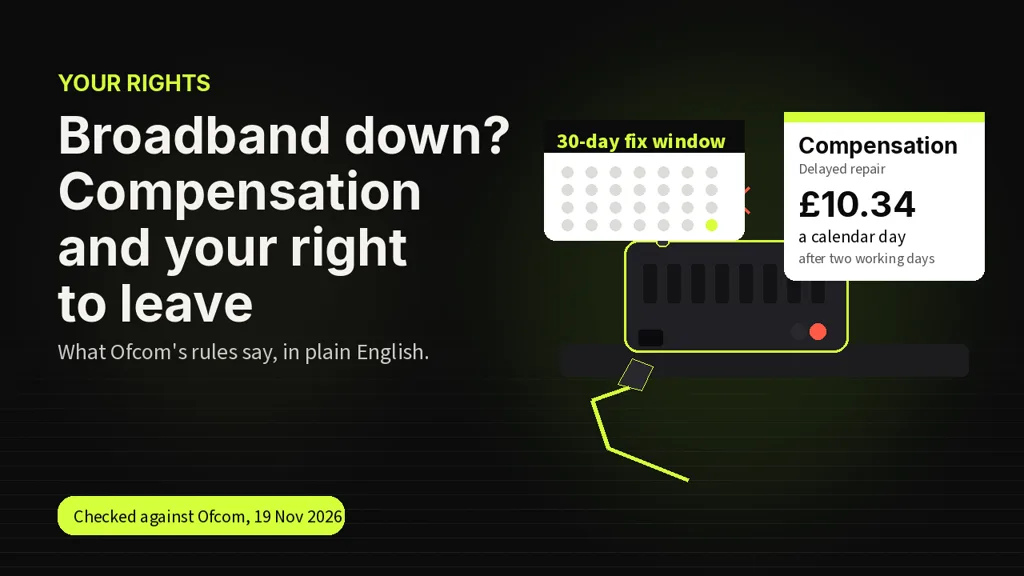
In short. If a signed-up provider leaves you without home broadband or landline after two full working days, Ofcom's automatic compensation scheme pays £10.34 a calendar day from 1 April 2026, without you having to ask. If speeds stay below the minimum you were promised and the provider cannot fix that within 30 days, you may be able to leave without an early exit fee. If a complaint is still unresolved after six weeks, or you get a deadlock letter, you can take it to an Ofcom-approved ADR scheme for free.
This is general information, not advice. Always check the official pages, which can change, and your own contract. Figures below were read on those pages on 19 November 2026.
Automatic compensation if the service is down
Ofcom's automatic compensation scheme means you can get money back from a signed-up broadband or landline provider when certain things go wrong, without having to ask. It covers residential fixed broadband and landline products. Ofcom: Automatic compensation: what you need to know (updated 20 July 2026)
Ofcom says these amounts apply from 1 April 2026 and increase each year in line with inflation. Ofcom: automatic compensation payouts from 1 April 2026 You should receive an initial £10.34 if the service is not fixed two full working days after you report it, and then £10.34 for each full day it is still not fixed after that.
For a delayed start or a missed appointment, the payment should be automatic. For a loss of service, you need to report the fault. Unless you agree otherwise, compensation is a credit on your bill, due no later than 30 calendar days after the problem is resolved or the service ends (or after the missed appointment, or after a delayed start is resolved or cancelled).
If your landline and broadband both go down at the same time, you only receive one payment. Providers can later limit how long payments continue: after 30 days of payments, they can give a further 30 days' notice, and they must take reasonable steps to offer a suitable alternative. If they cannot, you should still be entitled to the scheme payments.
You may not be paid under the scheme if the loss was caused by equipment or activity in your home, if you broke the contract, or if you caused the failure or delayed the repair — for example by asking for a later engineer visit than the one offered.
Who is signed up
Ofcom's list, updated 20 July 2026, is: BT, EE, Hyperoptic, Plusnet, Sky (including NOW Broadband), TalkTalk, Utility Warehouse, Virgin Media, Vodafone and Zen Internet. TalkTalk has restrictions for customers who are not on the Openreach network. If your provider is not on that list, do not assume the same payments apply — ask them, and complain if you are left without service.
The right to leave if speeds stay too slow
When you buy broadband, a provider signed up to Ofcom's Broadband Speeds Code of Practice should give you a minimum guaranteed download speed. If you think the service is slower than that, contact them to diagnose the problem. If the problem is on their network and they cannot fix it within 30 days, they must offer you the right to exit the contract without an early exit fee. Ofcom: Broadband speeds: what you need to know
Ofcom's 2022 residential code also says this applies where the actual download speed has been below that minimum on a daily basis for at least three successive days after you reported the problem, and the problem has not been resolved within 30 calendar days. The provider can offer the right to leave sooner if it has taken all reasonable steps and the speed is still too low. Ofcom: 2022 Voluntary Code of Practice on broadband speeds (residential) (PDF)
The right can also apply to bundled products that are linked financially, contractually or technically. "Without penalty" means no early termination fee, and a pro-rata refund of fees paid upfront, such as advance line rental. The provider may charge a reasonable amount for equipment that is not returned when asked.
If you are on a rolling monthly contract, this process does not apply — you can usually give notice (often a month) and leave anyway.
Who has signed up to the speeds code
Ofcom's consumer page lists: BT, EE, NOW Broadband, Plusnet, Sky, TalkTalk, Utility Warehouse, Virgin Media and Zen Internet. That list is not the same as the automatic compensation list. For example, Vodafone and Hyperoptic appear on Ofcom's compensation list, but not on this speeds-code list. If your provider is not listed, ask them what they will do if speeds stay below the guarantee.
How to complain, and when to go to the ombudsman
Start with your provider's customer services. If that does not resolve it, make a formal complaint. Ofcom says every phone and broadband company must have a complaints code that is easy to find, with a phone number (free or charged at a geographic rate), a postal address, and an email address or web form.
If the complaint is still unresolved, you have a right to use an alternative dispute resolution (ADR) scheme for free. Ofcom currently approves two schemes: Communications Ombudsman (the name used since July 2023; it was previously Ombudsman Services) and the Communication & Internet Services Adjudication Scheme, CISAS (CEDR).
You can take a complaint to ADR if:
- you are a residential customer, a small business (up to 10 employees), or a not-for-profit organisation where up to 10 people work, not counting volunteers;
- you have already raised the complaint with your provider and it is still unresolved;
- at least six weeks have passed since you first complained, or you have received a deadlock letter (you can ask for one); and
- it has been less than 12 months since you received a deadlock letter.
That six-week wait is the current rule on Ofcom's ADR page, updated 6 August 2026. It applies to complaints first raised on or after 8 April 2026. Complaints first raised before that date still used the previous eight-week wait, unless a deadlock letter arrived sooner. Ofcom: Making a complaint and using ADR schemes (updated 6 August 2026); Ofcom: Review of ADR in the telecoms sector
Which scheme your provider belongs to
Ofcom's list, as checked on 19 November 2026:
- CISAS: NOW, O2, Sky, SMARTY, TalkTalk, Three, Virgin Media, Vodafone and VOXI.
- Communications Ombudsman: BT, EE, giffgaff, iD Mobile, Lebara, Plusnet, Tesco Mobile, Utility Warehouse and Lyca Mobile.
If your provider is not listed, Ofcom says you can check with the schemes. Keep copies of your complaint, account numbers and any deadlock letter.
What to do next
If the line is down, report the fault and keep the date. If speeds are poor, report that too and ask for your minimum guaranteed speed in writing. If you are coming to the end of a contract, or you have been offered a renewal, check the dates and the real cost of a new deal first.
Compare broadband dealsCheck before you renewContract-end reminders
Sources
- Ofcom: Automatic compensation: what you need to know (updated 20 July 2026)
- Ofcom: automatic compensation payouts from 1 April 2026
- Ofcom: Broadband speeds: what you need to know
- Ofcom: 2022 Voluntary Code of Practice on broadband speeds (residential) (PDF)
- Ofcom: Making a complaint and using ADR schemes (updated 6 August 2026)
- Ofcom: Review of ADR in the telecoms sector
- Communications Ombudsman
- CISAS (CEDR)
Pages read on 19 November 2026. Ofcom can update rates, signatory lists and waiting times, so treat the official page as the source of truth. This is general information about published rules, not personal advice.
Questions
How much compensation do I get if my broadband is down?
If your provider is signed up to Ofcom's automatic compensation scheme and the service is not fully fixed after two full working days from when you reported the fault, the rate from 1 April 2026 is £10.34 for each calendar day it stays unrepaired. A missed engineer appointment, or one cancelled with less than 24 hours' notice, is £32.31. A delayed start of a new service is £6.46 for each calendar day of delay. Ofcom says the amounts rise with inflation each year. Source: Ofcom's automatic compensation guide, updated 20 July 2026.
Which providers are signed up to automatic compensation?
Ofcom's list, as updated on 20 July 2026, is BT, EE, Hyperoptic, Plusnet, Sky (including NOW Broadband), TalkTalk, Utility Warehouse, Virgin Media, Vodafone and Zen Internet. TalkTalk has restrictions for customers who are not on the Openreach network. The scheme covers residential fixed broadband and landline products. If your provider is not listed, ask them what they will pay, and complain if you need to.
Can I leave my contract if my broadband is too slow?
If your provider is signed up to Ofcom's Broadband Speeds Code of Practice and the problem is on their network, they must offer you the right to exit without an early exit fee if they cannot fix it within 30 days. You should have been given a minimum guaranteed download speed when you bought the service. Ofcom's 2022 residential code also says the speed needs to have been below that minimum on at least three successive days after you reported the problem. The process does not apply to a rolling monthly contract, because you can usually give notice anyway. This can also apply to bundled services.
How do I complain and take it to the ombudsman?
Contact customer services first, then make a formal complaint. Ofcom says you can take an unresolved complaint to a free ADR scheme after at least six weeks, or sooner if you receive a deadlock letter. You usually have 12 months from that letter. Ofcom approves two schemes: Communications Ombudsman and CISAS. Which one you use depends on your provider. The rule is on Ofcom's ADR page, updated 6 August 2026.
What if my provider isn't on Ofcom's lists?
Ask the provider which ADR scheme they belong to, and whether the automatic compensation scheme or the speeds code applies to your product. If a company is not on Ofcom's signatory list, those particular payments or the right-to-exit process may not apply, but you can still complain and, if needed, use ADR.